

Core Summary
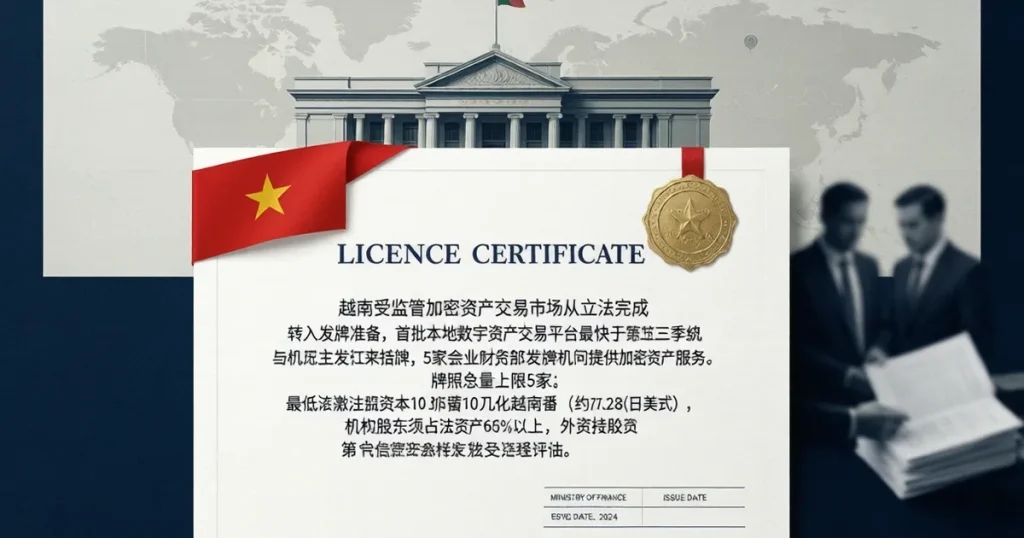
- Vietnam's first batch of regulated digital asset trading platforms were first established in [year missing]. Third quarter of 2026The launch and pilot program were based on the following criteria: Resolution No. 05/2025/NQ-CPThe pilot period is five years, starting from September 9, 2025.
- The total number of licenses is capped at 100%. 5The selection process was conducted by the Ministry of Finance in conjunction with the Ministry of Public Security and the State Bank of Vietnam; currently, five companies have been selected.Approval in principleHowever, approval in principle does not equate to obtaining a license.
- The entry threshold is the minimum paid-in registered capital. 10 trillion Vietnamese dong(Approximately US$3.8 million), institutional shareholders must contribute at least 65% of the registered capital, and foreign shareholding is capped. 49 %.
- Information technology systems must meet certain requirements before operation.Level 4 Information Security StandardThe application materials must include the Ministry of Public Security's assessment of the system security plan.
- One of the driving forces is the pressure from FATF reforms—Vietnam has been listed as a FATF member since June 2023.Gray listThe regulation of virtual asset service providers is one of the areas requiring rectification.
📑 Table of Contents
- Pilot Program Progress: From Approval in Principle to Formal Licensing — Current stage of 5 companies and FATF rectification background
- Entry barriers: Triple constraints of capital, equity, and information security — Requirements for paid-in capital and shareholder structure of 10 trillion Vietnamese dong
- Timeline of license issuance: Four legal milestones — 20-day guidance, 12 months for supplementary documents, 30-day review, 30-day opening
- Impact on applicants and regional licensed authorities — The scarcity of licenses and restrictions on cross-border business operations under total volume control
- FAQ
Aiying is a compliance consulting firm specializing in traditional finance and Web3. This article is original content from our team and requires authorization to reproduce.
The rollout of Vietnam's regulated cryptocurrency trading market has recently shifted from "legislation completion" to "license issuance preparation." According to The Business Times, the first batch of local digital asset trading platforms could launch as early as the third quarter of 2026 ( as reported by Wu Blockchain, August 19, 2026 ). For institutions planning to enter the Vietnamese market or assessing their Southeast Asian licensing strategies, the real hurdle lies not in the timeline, but in the capital, equity, and information security conditions set forth in the regulations.
Pilot Program Progress: From Approval in Principle to Formal Licensing
Five companies have received in-principle approval, but have not yet obtained licenses.
The State Securities Commission of Vietnam (SSC) has established a Crypto Asset Trading Market Management Committee. At the Ho Chi Minh City Science and Technology Festival (Conviction 2026) held on August 14-15, 2026, Tô Trần Hòa, the committee's permanent deputy director, stated that the basic management framework for the market has been completed in accordance with the principle of "setting strict operating conditions." Five companies have received in-principle approval and are currently completing Level 4 information security requirements, business processes, and the obligation to contribute 10 trillion VND before they can officially participate in the pilot program ( Vietnam Government Newspaper, August 14, 2026 ).
The legal distinction here is particularly crucial for applicants: the approval in principle under Resolution 05/2025/NQ-CP is merely a preparatory permit and does not constitute a license . According to Article 4, Paragraph 4 of that resolution, only institutions licensed by the Ministry of Finance can provide crypto-asset services and conduct related advertising and marketing; furthermore, according to Article 17, Paragraph 1(d), the Ministry of Finance, in conjunction with the Ministry of Public Security and the State Bank of Vietnam, can select a maximum of five service providers ( vietnam.vn, 2026-08 ). Therefore, there are currently no licensed crypto-asset trading platforms in the Vietnamese market, and the official operating date is uncertain.
The pressure of rectification deadlines imposed by the FATF grey list
The external impetus for accelerating the pilot program stems from anti-money laundering assessments. Due to strategic deficiencies in anti-money laundering, counter-terrorism financing, and non-proliferation financing, Vietnam was placed on the FATF grey list in June 2023 and has missed the deadline for rectification. There are 10 areas requiring improvement, including the regulation of virtual assets and service providers, as well as suspicious transaction reporting, financial intelligence, risk-based regulation, and beneficial ownership transparency. Market size also underscores the urgency of rectification: Vietnam had over 17 million cryptocurrency holders in 2024, and transaction volume exceeded US$200 billion in the year ending June 2025, a year-on-year increase of 55%. Migrating transactions to licensed virtual asset service providers and including them in the registration and tracking system is a core path for Vietnam to meet FATF requirements.
Entry barriers: Triple constraints of capital, equity, and information security
10 trillion Vietnamese dong paid-in capital and shareholder structure of compulsory institutions
Prospective licensed operators must meet a minimum paid-up registered capital of 10 trillion Vietnamese dong (approximately US$3.818 million). This threshold is high among similar licenses in Southeast Asia, effectively limiting applicants to entities at the banking and financial group level.
The equity structure is also subject to strict constraints: the resolution requires that at least 65% of the registered capital must be contributed by institutional shareholders or members ; of which more than 35% must be contributed by at least two institutions belonging to the commercial banking, securities, fund management, insurance, or technology sectors. This design means that trading platform teams with purely technical backgrounds can hardly meet the requirements independently and must form a joint venture structure with licensed financial institutions.
Foreign investment cap of 49%, restrictions on settlement and issuance of Vietnamese dong
Foreign investors may not contribute or purchase more than 49% of the registered capital , meaning foreign capital cannot acquire a controlling stake. All transactions must be denominated in Vietnamese Dong and comply with the FATF Travel Rule to strengthen the control of capital flows.
There is an easily overlooked restriction in the issuance process: according to the issuance principles explained by To Tran Hoa, Vietnamese companies issue crypto assets based on real assets and target foreign investors, and only foreign investors can buy and sell these assets. This principle separates RWA's tokenization business from the local retail market, directly affecting customer segmentation and sales suitability arrangements for related products.
Level 4 Information Security and Ministry of Public Security Pre-assessment
Information technology systems must meet Level 4 system information security standards before being put into operation and development . License application documents must include an assessment document issued by the Ministry of Public Security regarding the system security plan , as well as proof of capital contribution, audited financial statements or a report on registered capital contribution, and materials detailing shareholders, premises, personnel, and business processes. For applicants, the Ministry of Public Security's assessment is an external dependency and typically constitutes the most difficult part of the timeline to reduce.
Timeline of license issuance: Four legal milestones
20-day guidance, 12 months for supplementary documents, 30-day review
The resolution sets processing time limits for each stage, creating a measurable application path:
- Within 20 days of receiving the initial materialsThe Ministry of Finance issued a document guiding companies to complete the remaining procedures.
- The maximum period thereafter is 12 months.The company must provide all the necessary materials, including shareholder information, premises information, system security assessment, and proof of investment.
- Within 30 days after all materials are readyThe Ministry of Finance, together with the Ministry of Public Security and the State Bank of Vietnam, will review and issue the license, or provide a written reply stating that approval is not granted.
The company is required to issue a public notice within 7 working days of obtaining the license and has an obligation to open for business within 30 days.
Businesses must announce the date of formal service provision within 7 working days of receiving the license and commence operations within 30 days of obtaining the license , except in cases of force majeure. This arrangement eliminates the possibility of holding the license indefinitely without using it; applicants must complete the preparation of systems, personnel, and business operations during the material submission stage.
Although the timeframe is clear, the official operation date still depends on the preparation progress of each company—Su Chenhe also made this statement.
Impact on applicants and regional licensed authorities
The scarcity of license plates under total quantity control
The five-entry limit, coupled with the requirement of 10 trillion Vietnamese dong in paid-in capital and a 65% institutional shareholder, makes Vietnamese cryptocurrency trading licenses inherently scarce upon approval. For institutions not included in the initial list, the options are primarily narrowed down to acquiring stakes in entities that have already received in-principle approval, joining a joint venture as a technology-based shareholder, or waiting for policy adjustments after the pilot period ends. The pilot period is five years, commencing on September 9, 2025.
Restrictions on overseas platforms and risks of cross-border business development
According to ChainCatcher, applicants who have passed the initial review include affiliates of Techcombank, VPBank, and LPBank, as well as VIX Securities and Sun Group. The Vietnamese Ministry of Finance is also drafting rules to prohibit Vietnamese citizens from trading on overseas cryptocurrency platforms ( ChainCatcher, reprinted by KuCoin ). The above list and proposed rules have not yet appeared in official announcements; please refer to subsequent disclosures from the Ministry of Finance and the State Securities Commission for further information.
If restrictions on overseas platforms are ultimately implemented, offshore exchanges providing services to Vietnamese users will face questions about the legality of their operations in Vietnam. For institutions already licensed in Singapore, Hong Kong, or Dubai, entry into the Vietnamese market is more likely to involve cooperation or equity participation with local licensed entities, rather than direct cross-border customer acquisition. Vietnam is also using the Ho Chi Minh City and Da Nang International Financial Centre framework as a framework for sandbox testing of new services and technologies, providing another experimental channel for specific businesses.
FAQ
Can foreign institutions directly apply for and acquire controlling stakes in Vietnam's cryptocurrency trading license?
Controlling stakes are not permitted. Resolution 05/2025/NQ-CP stipulates that the total amount of foreign investment or share purchases cannot exceed 49% of the registered capital , and at least 65% of the registered capital must be contributed by institutional shareholders, with more than 35% of that contribution coming from at least two institutions in the commercial bank, securities, fund management, insurance, or technology sectors. Foreign investment typically requires participation through joint ventures with local Vietnamese financial institutions, and the shareholding ratio is subject to upper limits.
Are the five companies that have received in-principle approval allowed to begin trading?
No. The approval in principle is a preparatory stage permit; only institutions licensed by the Ministry of Finance can provide crypto asset services. These five companies still need to complete Level 4 information security certification, business process verification, a 10 trillion VND capital contribution, and submit complete application materials. They will only be granted licenses after review by the Ministry of Finance in conjunction with the Ministry of Public Security and the State Bank of Vietnam, and will then be allowed to commence operations within 30 days. As of August 2026, there are no licensed crypto asset trading platforms operating in Vietnam.
来源:
- Vietnam Government Newspaper (Báo Chính phủ): Digital Assets, Crypto Assets—Potential New Capital Channels, 2026-08-14
- vietnam.vn: Why Crypto Asset Exchanges Still Have No Determined Operating Dates (Detailed Explanation of Licensing Procedures under Resolution 05/2025/NQ-CP), 2026-08
- Wu Blockchain: Vietnam plans to launch a regulated crypto market pilot program in the third quarter of 2026 (quoted from The Business Times), August 19, 2026
- ChainCatcher (reprinted from KuCoin): Vietnam to launch regulated cryptocurrency trading pilot in Q3, 2026-08